If My Privilege Fails, What Happen to Those Without?
As a large, well-muscled man with a shaved head and an AuDHD neurological profile, I navigate the world with a flat affect and highly precise, clinical language. I am aware of my presence. I am also highly infragile, meaning I am fully capable of self-advocating when a system pushes back.
But what happens to the patients who aren't?
Recently, I experienced a severe breakdown in clinical culture at a local pharmacy. I was seeking a simple over-the-counter bronchodilator. Instead of receiving medical assistance, I was immediately treated as a precursor liability by staff who were both factually incorrect about the medication and hostile to my attempts to clarify. They profiled me, stonewalled me, and offered condescending, unsolicited advice outside their depth.
I walked away fine, but the interaction struck a nerve. It perfectly mirrored the exact type of medical gaslighting and aggressive gatekeeping I see the women I coach face every day.
When women in the 30-55 age bracket approach the medical system seeking Hormone Replacement Therapy (HRT) or relief from the debilitating symptoms of perimenopause, they are routinely dismissed. They are told their symptoms are "just part of aging," prescribed antidepressants instead of hormones, or made to feel like a nuisance for asking questions.
If a highly articulate, physically imposing man gets aggressively stonewalled over a simple OTC/BTC inhaler, the friction a woman faces when advocating for her complex hormonal health is monumental.
I wrote the following letter to the District Pharmacist. I am sharing it publicly not to air a grievance, but to serve as an example of how to push back. We must demand better clinical culture, and we must build the physical and mental resilience to advocate for ourselves.
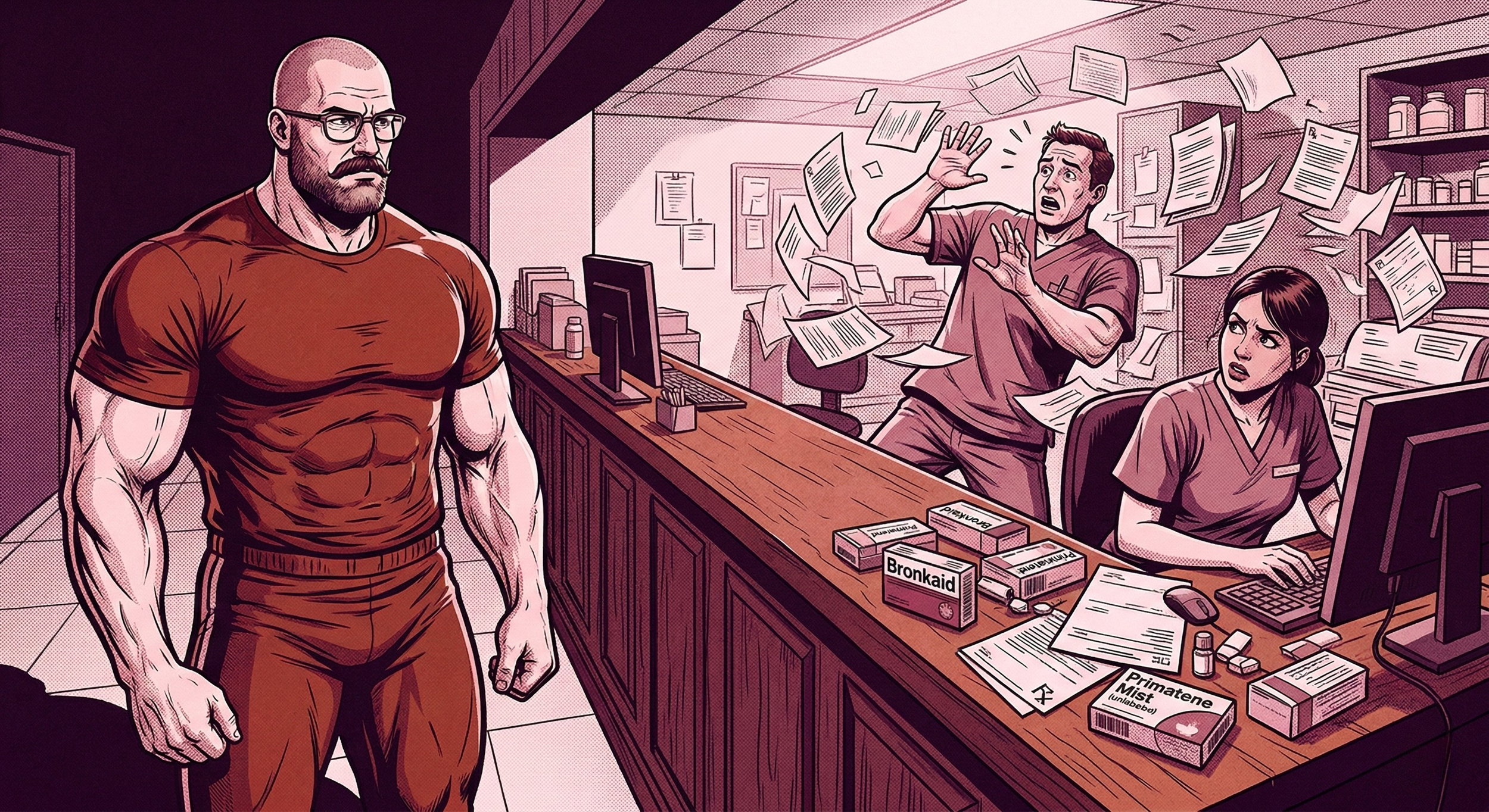
PULP ART PHARMACY. A WILDLY EXAGGERATED CARICATURE
Note: To satisfy corporate legal, everyone depicted here has received a significant visual upgrade. The man is not this 'improbably jacked,' the pharmacist was balding, and the technician was... a different person entirely. This illustrative absurdity highlights the difference between 'Perceived Threat' and 'Actual Intent'.
An Open Letter to CVS Pharmacy Leadership
To: CVS District Pharmacy Leadership, Tempe Region
Subject: Patient feedback regarding precursor screening protocol at Rural and Elliot
To the Respective District Pharmacist,
I am publishing this open letter; which has also been routed through internal CVS channels, to provide a formal account of a recent experience at the Rural and Elliot CVS pharmacy location. My goal is to highlight a specific breakdown in clinical culture regarding over-the-counter (OTC) or behind-the-counter (BTC) medication dispensing protocols, while also recognizing several standout members of your team.
The Staff I Wish to Commend
There are several Pharmacists, PAs, and technicians at this location who consistently provide exceptional service. I regret not knowing names and having to resort to vague descriptions. If I have at all missed the mark in my descriptions, that was not my intent, as their conduct is worthy of me knowing their preferred designations. I want to explicitly praise the newer, taller female technician who professionally escalated my inquiry when needed, the experienced pharmacist or technician with the bob haircut who is consistently competent, and the shorter male technician with the bowl cut who always handles my complex prescription logistics with absolute professionalism. These individuals meet me where I am, bypassing any assumptions, and I deeply appreciate their work.
The Incident
My negative experience involves the male pharmacist or tech on duty wearing scrubs and the female technician working at the standing computer. I approached the counter seeking an over-the-counter bronchodilator. I imprecisely asked for an ephedra inhaler rather than specifying epinephrine or Primatene Mist, and offered Bronkaid as a secondary option. Rather than seeking clarification, the technician at the computer immediately and aggressively stated that these medications had required a prescription for years. When I attempted to gently correct this or update my priors, and expressed a willingness to provide ID for the log, she became hostile and eventually stonewalled me completely, ignoring my attempts to de-escalate. The pharmacist was similarly dismissive. He was unfamiliar with the stock, suggested I get an albuterol prescription, and offered unsolicited, condescending advice about wearing masks for dust, despite my background as an airbag inflator R&D engineer (specific domain knowledge on harmful particulate exhaust). After I found the retail tags proving the store carried both items, the pharmacist remained unhelpful, eventually claiming Primatene Mist was front-of-house. The front-of-house staff later confirmed the pharmacy handles Bronkaid. I left without the medication.
The Broader Concern
I am a large, well-muscled man with a shaved head. As an autistic and ADHD individual, I naturally employ a flat affect and highly precise, clinical language, especially when confusion arises. I understand this presentation can sometimes startle medical workers. However, the immediate jump to treat me as a precursor liability or a bully, rather than a patient seeking respiratory relief, is unacceptable. I am highly infragile and can self-advocate. My concern lies with the patients who cannot. I advocate in part for those women I serve who feel dismissed by the medical industry at large who seek HRT medication to relieve the symptoms of Perimenopause. The aggressive gatekeeping and misinformation displayed by the pharmacist and the computer technician will actively deter less assertive individuals from accessing necessary care. I ask that you review your protocols regarding bias and precursor screening with these specific staff members to ensure a more equitable environment.
Regards,
Blake Hill
Founder, Cacti Fit
The Takeaway: Forging Your Own Shield
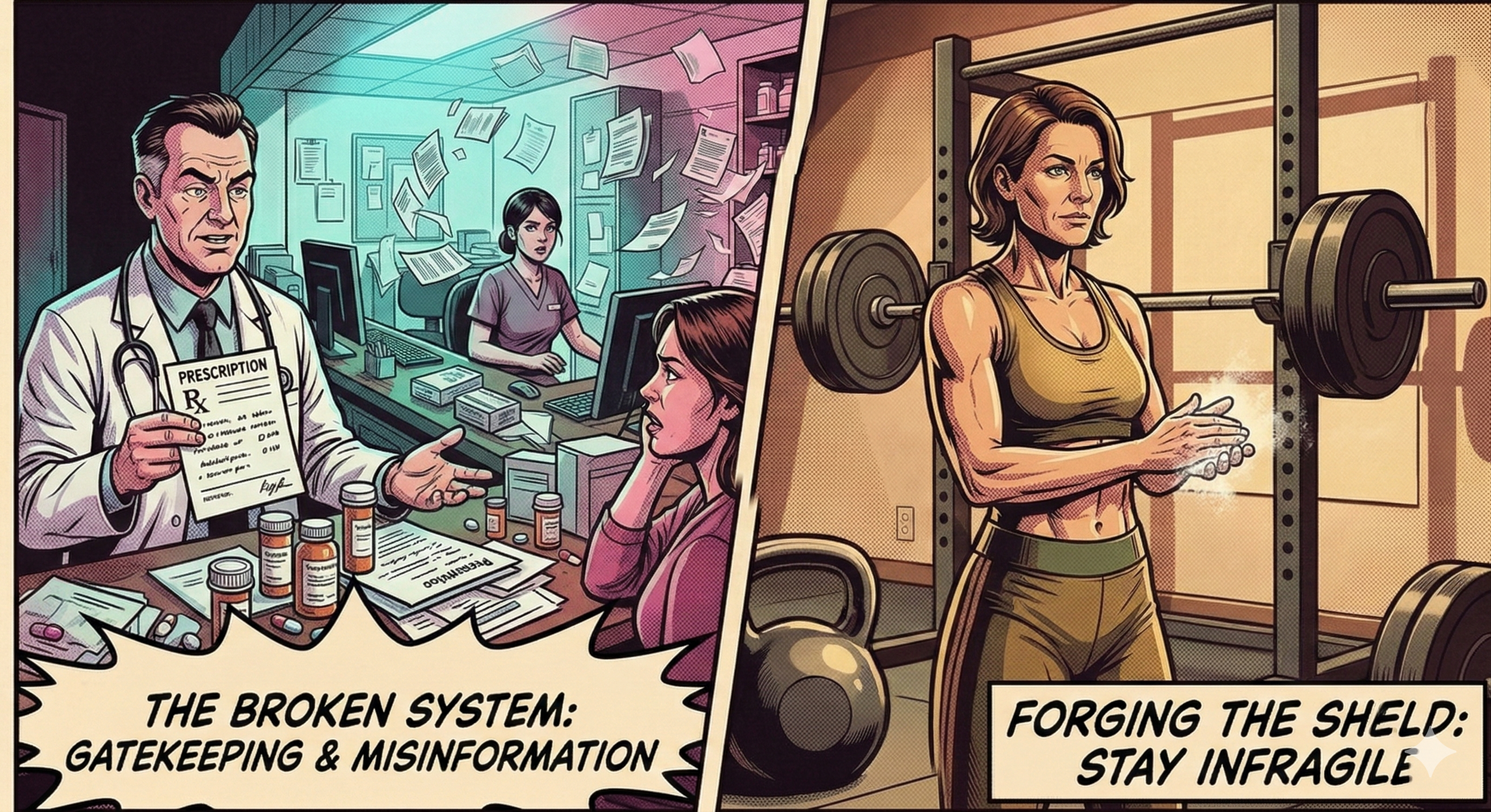
Embodying Infragility
We build the confidence in the weight room necessary to weather a broken system.
The medical system is often broken, biased, and inefficient. While we can and should hold these institutions accountable, as I have done by documenting this incident, our first line of defense must always be our own resilience. We cannot control the preconceptions of a stressed pharmacist or a dismissive clinician, but we can absolutely control the physical and psychological baseline we bring into that room.
Building your "metabolic armor" through deliberate strength training and taking agency over your healthspan isn't just about aesthetics or even longevity. It is a highly effective protective mechanism. When you possess the discipline to track your nutrition, lift heavy, and understand your own physiological data, you fundamentally change how you interact with medical authority. You stop being a passive recipient of generalized advice and become an active, informed participant in your own care.
Physical strength translates directly to conversational and boundary-setting strength. When you know exactly what your body is capable of, and you understand the data behind it, you do not readily accept "this is just a normal part of aging" as a catch-all diagnosis. You become harder to ignore, harder to gaslight, and significantly harder to dismiss.
Stay infragile.